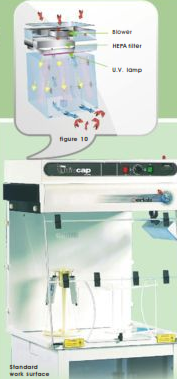
Designed to protect a RNA or DNA sample from cross-contamination, contamination from the room and from the operator during its amplification, the biocapTM RNA/DNA is equipped with a blower and a H14 HEPA filter (see figure 10). It works as a vertical laminar flow: the air from the room is blown into the enclosure through the H14 filter, preventing any DNAs or Rnases present in the room to contaminate the DNA or RNA sample. This air is ejected towards the operator, preventing contamination from the operator even when he introduces his hands into the enclosure. A U.V. lamp controlled by a timer is used to decontaminate the enclosure with C.U.V. rays between 2 successive PCR* experiments to avoid cross– contamination.
Using a BSC (Biological Safety Cabinet class II, figure 12) is not ideal for PCR, since a BSC is designed to protect the sample and the operator. But for PCR the main problem is to protect the sample against the operator (See figure 11). Using a BSC may provoke a contamination of the DNA sample by the DNAs or Rnases of the operator.
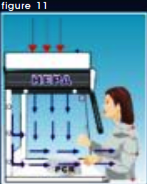
biocap RNA/DNA
The airflow ejected towards the user pushes back the possible DNAs and RNAses emitted by the operator
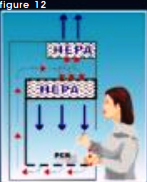
BSC (Biological safety Cabinet Class II)
The airflow entering the enclosure may carry along the DNAs and RNAses emitted by the operator into the working enclosure
Dimensions
| (mm) | Length | Depth | Height | ||
|---|---|---|---|---|---|
| Int | 601 | x | 585 | x | 600 |
| Ext | 653 | x | 610 | x | 785 |
| Specifications | |
|---|---|
| Filter type | H14HEPA Filter( 99, 995 % for 0, 3μ ) |
| Volume of air treated | 175 m^3/h |
| Average face velocity | 0,53 m/s |
| Internal volume of the enclosure | 0,2 m^3 |
| Total power consumption | 73 Watt |
| Maximum Amperage absorbed | 0,30 A |
| Voltage/Frequency | According to the country of delivery |
| Blower | 1 turbine type |
| Noise level | 55 dbA |